
Last updated November 16, 2026
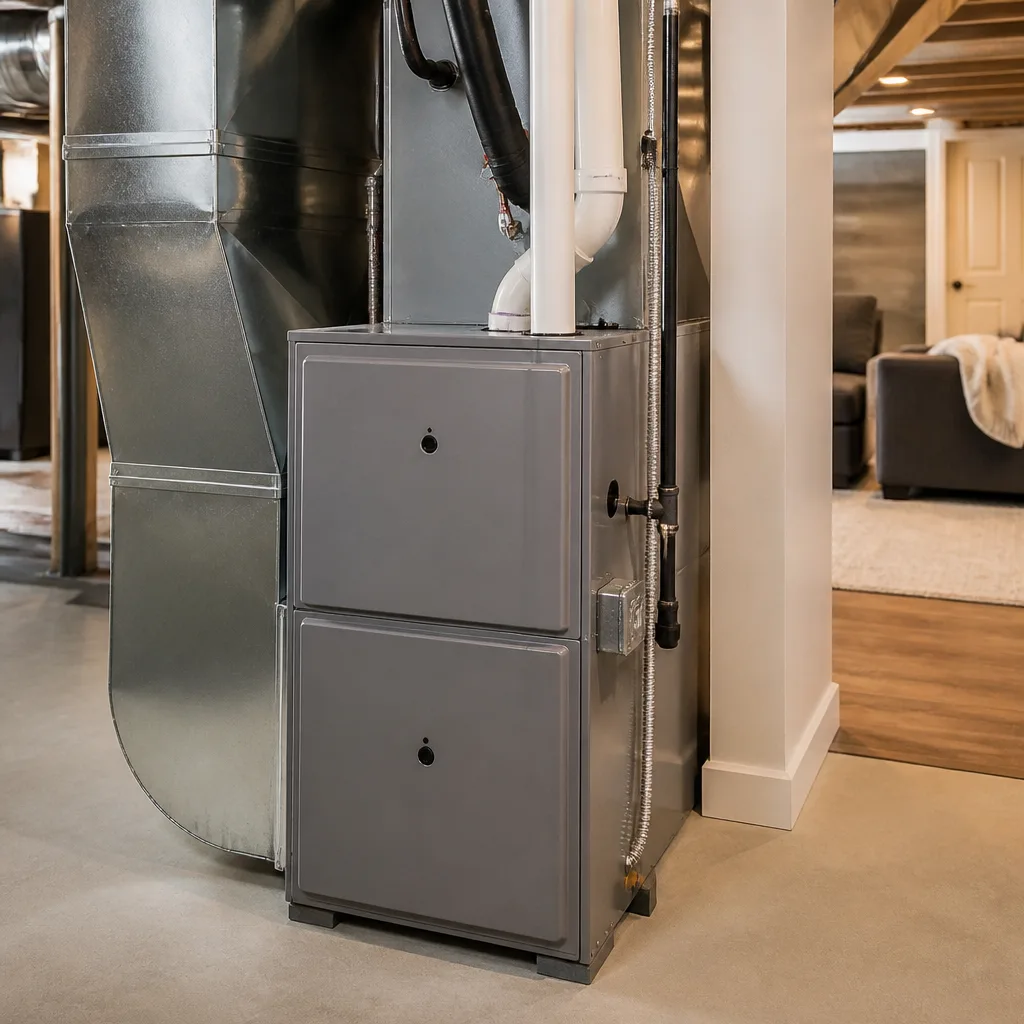 Furnace & heating
 AC repair
 Heat pumps
 Ductless mini splits
 Carrier
 Trane
 Goodman
Seasonal tune-up and full diagnostic on your Carrier, Trane, or Goodman system - readings shown to you before any repair is proposed
Diagnosis first, numbers second - you approve the repair price before a single part goes in.
Get your free estimateFurnace Replacement Troubleshooting in Burbank: Common Problems and How to Fix Them
A cracked heat exchanger gets called a mandatory full replacement by some contractors and a manageable repair by others, and the difference often comes down to something most homeowners never think to ask: whether the crack is in the primary exchanger or the secondary one. That single detail changes the safety conversation, the cost conversation, and whether you’re looking at a repair or a replacement at all. In our experience across Burbank, the majority of furnace replacement calls we walk into turn out to be fixable failures. This guide gives you a diagnostic framework to tell the difference before a technician arrives, so you can ask better questions and recognize a recommendation that actually holds up.
Quick Answer
Most furnace problems that get labeled “needs replacement” in Burbank are repairable – failed igniters, dirty flame sensors, control board faults, and short-cycling from oversized equipment. True replacement cases usually involve a heat exchanger fracture in a specific location, a control board that’s no longer made, repeated igniter failures, a gas valve on a unit over 18 years old, or a blower motor burnout on a system with other serious problems. A proper replacement recommendation includes combustion analysis, a load calculation, and a look at your existing ductwork.
Styles & brands we work with
- AC repair
- Furnace & heating
- Heat pumps
- Ductless mini splits
- Carrier
- Trane
- Goodman
Table of Contents
- The Five Failure Modes That Actually Justify Replacement
- How to Decode Your Furnace’s Blinking Error Code
- Why Short-Cycling in Burbank Is Rarely the Heat Exchanger
- The 50% Rule and a Better Calculation You Can Run Yourself
- Red Flags in a Replacement Recommendation
- Primary vs. Secondary Heat Exchanger: Why Location Matters
- Questions to Ask Before the Technician Arrives
- What a Real Diagnostic Actually Looks Like
The Five Failure Modes That Actually Justify Replacement
Replacement isn’t a judgment call about age or brand. It’s a decision about whether repairing a specific failed component restores reliable heat for a reasonable cost relative to what’s left of the system’s life. These five conditions are the ones where replacement genuinely makes more sense than repair in most Burbank homes.
- Heat exchanger fracture in a load-bearing or non-welded section. A crack or hole in the primary heat exchanger is a safety issue, because combustion gases can mix with the air moving through your home. Fractures in the secondary exchanger range from serious to repairable depending on the location and the metallurgy. Units with a compromised primary exchanger are replacement candidates.
- Control board obsolescence. When a control board fails and the part is discontinued, the repair becomes a scavenger hunt. A board that’s no longer manufactured means either a used replacement of unknown remaining life or a full unit swap.
- Repeated igniter failure cycles. One failed igniter is routine. Three or four over a couple of seasons points to an underlying condition – excess moisture, incorrect gas pressure, a hot surface that’s cycling the igniter too hard – that will keep eating igniters until it’s diagnosed properly.
- Gas valve failure on units over 18 years old. The gas valve is the heart of the ignition sequence. Replacing one on a unit that’s closing in on two decades asks you to bet on the heat exchanger, the blower, and the inducer surviving another several seasons.
- Blower motor burnout on systems with known refrigerant-side problems. If you have an older system that also needs refrigerant work, a blower failure may be the moment to replace the air handler or the whole unit rather than rebuild piece by piece.
None of these are decisions to make over the phone. Each needs an on-site diagnosis – combustion analysis, electrical checks, and a visual inspection of the exchanger with the proper tools. Our technicians work on the system you already have, whether that’s Trane, Lennox, Goodman, Rheem, or any of the nine major brands we’re certified to service, which means a diagnosis isn’t shaped by what we’d rather sell.
How to Decode Your Furnace’s Blinking Error Code
Most modern furnaces have a small LED light on the control board that blinks in a pattern to signal what the board thinks is wrong. Decoding that pattern before a technician arrives is the single fastest way to verify that their diagnosis matches the actual fault – and homeowners who do this catch misdiagnoses far more often than you’d expect.
Here’s how to read the code:
- Find the sight glass. The blinking light is usually visible through a small window on the lower or upper access panel. Remove the panel only if you’re comfortable and the power is off.
- Watch one full cycle. Codes repeat in a loop. Wait for the pattern to restart so you don’t count a partial sequence.
- Count the blinks between pauses. A pattern of “three blinks, pause, three blinks” means code 33. A single long blink may mean a lockout. Some boards pause between digits of a two-digit code.
- Look up the code in your owner’s manual or on the panel door. Every manufacturer prints a code chart behind the blower door. If it’s missing, the model and serial number tell you which chart applies.
- Write it down and bring it to the appointment. A code plus the conditions when it appears (on startup, after 10 seconds, only in cold weather) gets the technician to the right component faster.
Codes are a starting point, not a verdict. A code that says “flame sensed when it shouldn’t be” can point to a shorted wire, a stuck gas valve, or a control board that’s misreading input. The code tells you where to look, not always what’s wrong. In our experience in Burbank, the most common misdiagnosis happens when a code gets read as a heat exchanger failure without a combustion test backing it up.
Why Short-Cycling in Burbank Is Rarely the Heat Exchanger
When a furnace kicks on and off every few minutes, the instinct is to fear the worst – a cracked exchanger, a dying unit, an imminent replacement. In Burbank’s mild climate, that instinct is almost always wrong. Short-cycling here is usually a dirty flame sensor or an oversized furnace doing exactly what it was designed to do in weather that doesn’t need it.
Here’s why that distinction matters. Burbank winters are gentle enough that a furnace sized for the coldest nights runs for a much shorter cycle in typical weather. If the unit was oversized on installation, it reaches setpoint quickly, shuts off, cools, and restarts. That cycling looks alarming but doesn’t indicate a failed component – it indicates a unit that’s doing its job too fast. A dirty flame sensor makes the board think there’s no flame after ignition, so it shuts the gas valve and retries. Same symptom, different cause, and both are much less expensive than a replacement.
The short-cycle diagnosis:
- Count the cycles and note the interval. Two or three minutes of run time followed by several minutes off points toward sizing. Constant rapid cycling – 30 seconds on, 30 seconds off – points toward a flame sensor, a blocked flue, or a pressure switch fault.
- Check the thermostat. A thermostat placed near a heat source, in a draft, or near a return will trigger cycling on its own.
- Check the filter and return grille. Restricted airflow causes the high-limit switch to trip, which shuts the burner down before the house is warm.
- Listen for the inducer. If the draft inducer motor cycles with the burner, combustion-side faults are in play and need professional attention.
Burbank’s climate means a properly sized furnace might legitimately cycle more than the same model in a colder part of the country. That’s not a reason to replace it. It’s a reason to make sure the flame sensor, filter, and thermostat are doing what they should.
The 50% Rule and a Better Calculation You Can Run Yourself
The 50% rule says that if the cost of a repair exceeds half the cost of a new system, replace rather than repair. It’s a rough heuristic, not a law, and in our experience it produces bad decisions in both directions – sometimes pushing owners toward replacement when the repair would have bought them years, and sometimes encouraging repairs on equipment that’s already past its useful life. Here’s a more precise way to think about it.
The repair-versus-replace math has four inputs:
- What’s the remaining life of the system? A typical forced-air furnace has a useful service life in the range of 15 to 20 years. If your unit is 8 years old, you’re looking at roughly another 7 to 12. If it’s 17, you’re in the last years.
- What’s the cost of the repair? Get the number in writing before you decide anything.
- What’s the replacement cost, installed, with everything – ductwork corrections, venting, permit, load calculation? Not the equipment price. The installed price.
- What’s the probability of another failure in the next 24 months? Not a guess. Based on which components are original, which have been replaced, and whether the system’s been showing wear patterns.
The calculation: multiply the remaining life in years by the annual expected cost of ownership of keeping the old unit alive, add the cost of the repair you’re considering now, then compare against the installed replacement cost divided by the new unit’s expected life in years. If keeping the old unit costs more per year of remaining life than the new unit’s cost per year of full life, replacement wins. If keeping the old unit costs meaningfully less, repair buys you time without wasting money.
For a system being considered for furnace repair in Burbank, we walk through this math with every homeowner, and the answer sometimes points to repair even when the customer came in expecting to hear “replace it.” Whether it needs a repair or a full replacement, we’ll tell you which one actually makes sense.
Red Flags in a Replacement Recommendation
Not every replacement recommendation is wrong. Some are correct and necessary. But there are specific warning signs that the recommendation hasn’t been earned through real diagnostic work, and homeowners should know what to look for in the estimate conversation.
- No combustion analysis. A proper evaluation of a heat exchanger and burners includes measuring flue gas composition – carbon monoxide, oxygen, stack temperature. If the trip report doesn’t have numbers for those, the diagnosis is a guess.
- No mention of ductwork condition. A new furnace sized and installed without checking duct leakage, sizing, and insulation will perform like the old one. Any honest replacement conversation includes at least a basic duct assessment and a plan for sealing and balancing.
- No load calculation. Manual J is the standard method for sizing a furnace to a home. Skipping it and installing “the same size as what was there” perpetuates whatever mistake the previous installer made. A properly sized unit may be smaller than what you have – and that’s fine.
- Price quoted before diagnosis. “You need a full replacement, and it’s $X installed” without a written diagnostic summary is a bid, not a diagnosis.
- Refusal to repair because the unit is “old.” Age alone is not a failure. A 16-year-old furnace that passes combustion analysis and has no component failures is a running furnace, not a dead one.
- No discussion of the model and brand match. A replacement should be sized and configured to work with the existing venting, electrical, and gas supply. Recommendations that gloss over those details aren’t finished recommendations.
In our experience in Burbank homes, the strongest replacement recommendations we’ve seen come from contractors who spent real time under the house or in the closet with testing equipment – not from the ones who knew the price before they knew the model of the unit. When you’re comparing furnace repair against replacement, the quality of the diagnostic matters more than the brand on the door of the new unit.
Primary vs. Secondary Heat Exchanger: Why Location Matters
A “cracked heat exchanger” is one of the most consequential phrases in the furnace trade, and it’s regularly used without the qualifier that changes everything: which exchanger. High-efficiency furnaces have two – a primary exchanger where combustion happens, and a secondary exchanger that extracts additional heat from the flue gases before they vent. A fracture in the primary is a different problem from a fracture in the secondary, and the difference often separates a $400 fix from a four-figure replacement.
The primary exchanger is directly exposed to the burner flames. A crack or hole here allows combustion products to mix with the supply air. That’s a carbon monoxide risk and a hard replacement in almost every case. The secondary exchanger operates at lower temperatures and handles cooler flue gases. Cracks in it can also create CO risk, but they’re often smaller, sometimes weldable, and sometimes located where the unit can be safely repaired and monitored rather than immediately swapped.
Homeowners should know what to ask:
- Which exchanger – primary or secondary?
- Where on the exchanger – front, back, weld seam, tube bundle, header?
- How was it identified – visual inspection with a scope, or combustion analysis?
- Is there measurable CO in the supply air?
- If this were your furnace, what would you do?
Any answer that skips the location and testing details is not a complete diagnosis. Safety comes first here – a compromised primary exchanger is not something to run while you weigh the options. We recommend shutting the system off at the gas valve and calling for a professional inspection rather than trying to inspect or handle the exchanger yourself; it’s a component that demands trained eyes and proper testing.
Questions to Ask Before the Technician Arrives
The best way to protect yourself from a bad replacement recommendation is to walk into the appointment prepared. These questions are what we’d ask if our own furnace failed, and homeowners who’ve done this homework in Burbank consistently get more accurate diagnoses.
- What do the error codes mean in my specific model? Look up the chart behind the blower door and write down the sequence.
- When did the failure start, and under what conditions? On startup, after a few minutes, only when the house is coldest, only on the second cycle of the day – timing matters for diagnosis.
- What’s been replaced on this furnace so far? A unit that’s had the igniter replaced twice and the flame sensor three times has a story the technician needs.
- Have you noticed any smell, soot, or moisture? Combustion problems show up as soot on the flue, a metal smell, or water in the vent. Any of these and you should turn the system off.
- Where’s the gas shutoff and the electrical switch? These need to be accessible before the technician comes in.
- Do you have the model and serial number? The serial number decodes to the manufacture date in most brands, which matters for parts availability.
A homeowner who can answer these questions is a homeowner who won’t get sold a replacement they don’t need. In our experience, the majority of “urgent replacement” situations we walk into turn out to be diagnosable, fixable issues once the actual failure mode is identified – not because contractors are dishonest, but because the failure mode is often less alarming than it sounds.
What a Real Diagnostic Actually Looks Like
If a technician walks into your Burbank home and diagnoses a replacement-level failure in ten minutes without a toolbox, something is off. A proper furnace diagnostic takes time and involves specific tests and inspections. Knowing what those are helps you recognize when one has actually been done.
- Review the error codes and operating history. What the board is reporting, matched against the homeowner’s description of the failure.
- Inspect the ignition sequence. Call for heat, inducer start, pressure switch prove, ignition, flame sense, burners stabilize, blower on. Any step that fails or hesitates gets investigated.
- Test the flame sensor and igniter. Microamp reading on the flame sensor and static test on the igniter.
- Run combustion analysis. Flue gas CO and O2, stack temperature, and a check for flue gas spillage into the supply air.
- Inspect the heat exchangers with a scope. Both primary and secondary. Documentation of any cracks with location.
- Check the blower and inducer motors. Amp draw, bearings, capacitor condition.
- Verify gas pressure. Inlet and manifold pressure, checked against the unit’s rating plate.
- Evaluate airflow and filter condition. Static pressure check across the filter and evaporator coil.
Repairs performed range from a flame sensor clean-up to a control board replacement to a full blower motor swap, and the decision to recommend replacement is always made after the diagnostic is complete, not before. If you ever get a replacement quote without that diagnostic behind it, get a second opinion. Our AC installation side of the business sees the same pattern from the cooling side of the same equipment, which is one reason we treat every diagnosis the same way regardless of which half of the system is failing. For a closer look at how we approach whole-home climate decisions, start with AC Repair Burbank.
Common Mistakes to Avoid
- Treating age alone as a replacement trigger. A 17-year-old furnace that passes combustion analysis and has no component failures is still a running furnace. Age is a factor in the math, not a verdict on its own.
- Accepting a replacement recommendation without a combustion test. If the technician doesn’t measure flue gas CO and stack temperature, the diagnosis has no foundation. Ask for the numbers in writing.
- Skipping the load calculation on the new unit. Installing “the same size as what was there” repeats whatever mistake the original install made. Oversized furnaces short-cycle, which is one reason this matters so much in Burbank’s climate.
- Ignoring ductwork condition. A brand-new furnace connected to leaky, undersized ductwork performs like the unit it replaced. Any replacement conversation should include duct sealing and balancing.
- Assuming short-cycling means the heat exchanger. In Burbank, it usually means a dirty flame sensor, a filter problem, or an oversized unit doing what oversized units do.
- Letting a “cracked exchanger” diagnosis stand without location details. Primary and secondary exchanger cracks are different problems. Ask which one, where on it, and how it was found.
- Running a furnace you suspect of combustion problems while you decide. If you smell gas, see soot, or notice moisture in the flue, shut it off and call a professional. Carbon monoxide has no warning signs you can rely on detecting yourself.
See the difference
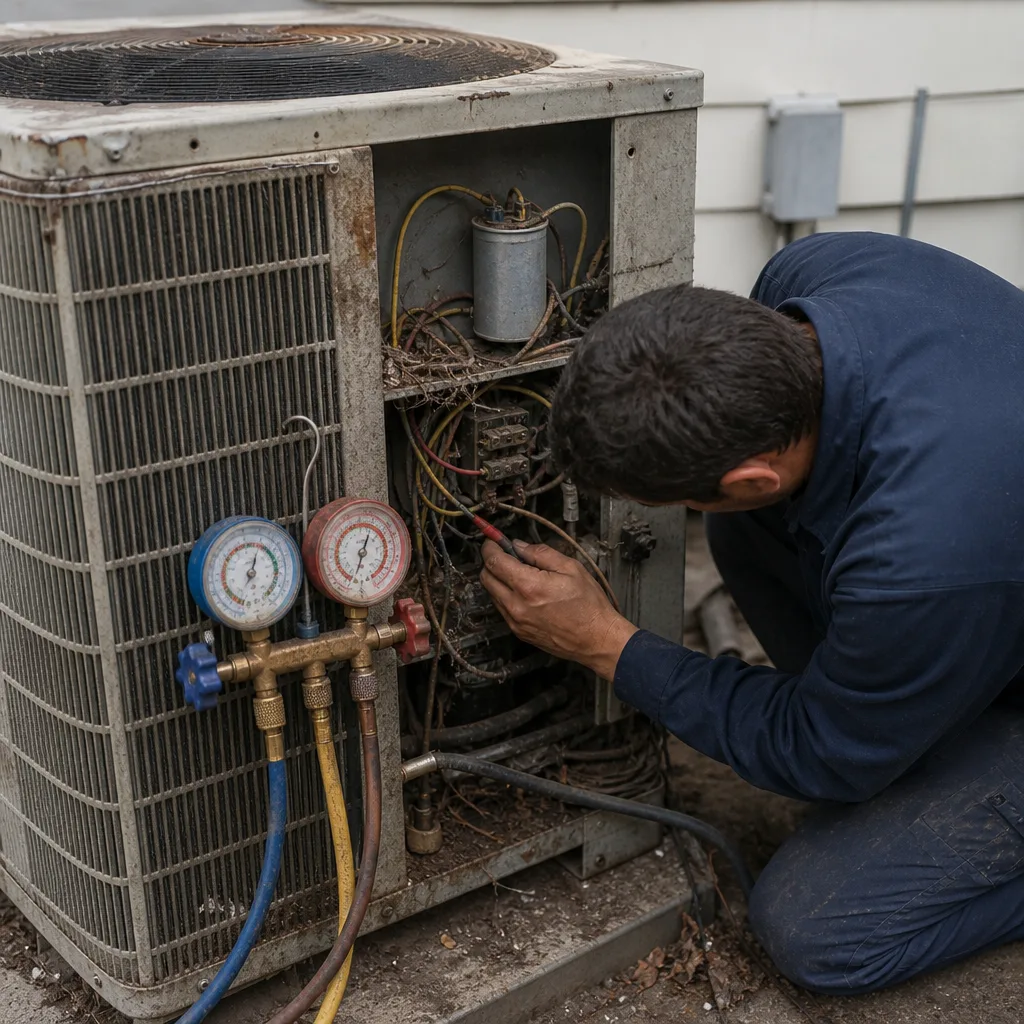 Before
 After
 Before
 After
 Before
 After
When to Call a Professional
Some furnace issues are safe to look at yourself – a filter, a thermostat setting, a tripped breaker. Others demand training and tools. Call a professional immediately if you smell gas, if the CO alarm sounds, if you see soot or moisture at the flue, if the burner runs but the blower doesn’t, or if the system has been cycling without producing heat.
The safe-to-investigate list is short: replace the filter, verify the thermostat is calling for heat, check the breaker at the panel. Anything past that – ignition sequence, gas valve, heat exchanger, control board – needs a technician. Combustion appliances are unforgiving of amateur diagnosis, and a heat exchanger that hasn’t been properly tested is not a component to second-guess.
AC Repair Burbank offers free estimates in Burbank. Call (844) 962-2046. We answer 24/7. Fast dispatch from 7am to 7pm, Sunday through Friday. Our technicians have up to experience and work on the system you already have – whether it’s a Trane, Lennox, or any of the other major brands we’re certified to service – with a written diagnostic before any recommendation.
Frequently Asked Questions
You know your furnace needs replacement when a diagnostic confirms one of five failure modes: a primary heat exchanger fracture, a discontinued control board, repeated igniter failures, a gas valve failure on a unit over 18 years old, or a blower motor burnout alongside other serious problems. Age alone, short-cycling, or an unfamiliar error code is not enough. Call (844) 962-2046 for a proper diagnostic – estimates are free.
You can address the two most common causes – replacing a clogged filter and checking the thermostat – yourself. If short-cycling continues after that, it’s a technician issue, because the likely culprits are a dirty flame sensor, a pressure switch fault, or an oversized unit. Call (844) 962-2046 for an exact quote – estimates are free.
A blinking error code tells you which system the control board thinks failed, not always what’s actually wrong. A code points to a component or condition the board is monitoring – flame sensing, pressure switch, limit switch – and a technician uses that as a starting point for actual testing. Write the pattern down before the appointment and bring it with you. Call (844) 962-2046 if you’re not sure what your code means.
No. The 50% rule is a rough heuristic, not a law, and it produces bad decisions in both directions. A better calculation compares the annual cost of keeping your current system running against the annual cost of a new system over its full expected life. In our experience, the precise math sometimes keeps an older unit in service for several more years. Call (844) 962-2046 to walk through the numbers with a technician – estimates are free.
Burbank’s mild winters mean furnaces here run shorter cycles than they would in colder parts of the country, and that shorter cycling is often mistaken for a failure. A properly sized furnace in a Burbank home may cycle more frequently without anything being wrong. Diagnosis should account for climate and cycling pattern, not just the symptom. Call (844) 962-2046 to schedule a proper diagnostic.
A furnace replacement is a scheduled job, not a same-day emergency fix. The timeline involves a proper load calculation, ordering the sized equipment, permit coordination where required, and the actual installation day. If you need the schematic work done promptly, get the diagnostic started early. AC installation follows the same schedule discipline on the cooling side; the plan is set in advance. Call (844) 962-2046 for a free estimate and a set install date.
If you’re not sure whether your situation is a repair or a replacement, start with a call. We answer 24/7. Fast dispatch from 7am to 7pm, Sunday through Friday.
The Bottom Line
Most furnace replacement calls in Burbank turn out to be fixable failures, which is why the diagnosis matters more than the recommendation. The five conditions that actually justify replacement are narrow and testable: a primary heat exchanger fracture, an obsolete control board, repeated igniter failures, a gas valve on an old unit, and a blower motor burnout on a struggling system. Short-cycling is usually a flame sensor, a filter, or an oversized unit. The 50% rule is a starting point, not a decision. And any replacement recommendation that skips combustion analysis, ductwork review, or a load calculation hasn’t been earned. Know what to ask, know what a real diagnostic looks like, and call (844) 962-2046 when you need someone who’ll tell you which option genuinely makes sense. Estimates are free.
Written by the team at AC Repair Burbank.